For more than a decade, the smartphone has been the center of digital life. It replaced cameras, maps, music players, wallets, alarm clocks, and even parts of the computer. But in 2026, the tech industry is clearly preparing for the next shift.
Phones are not disappearing. They are simply becoming less central.
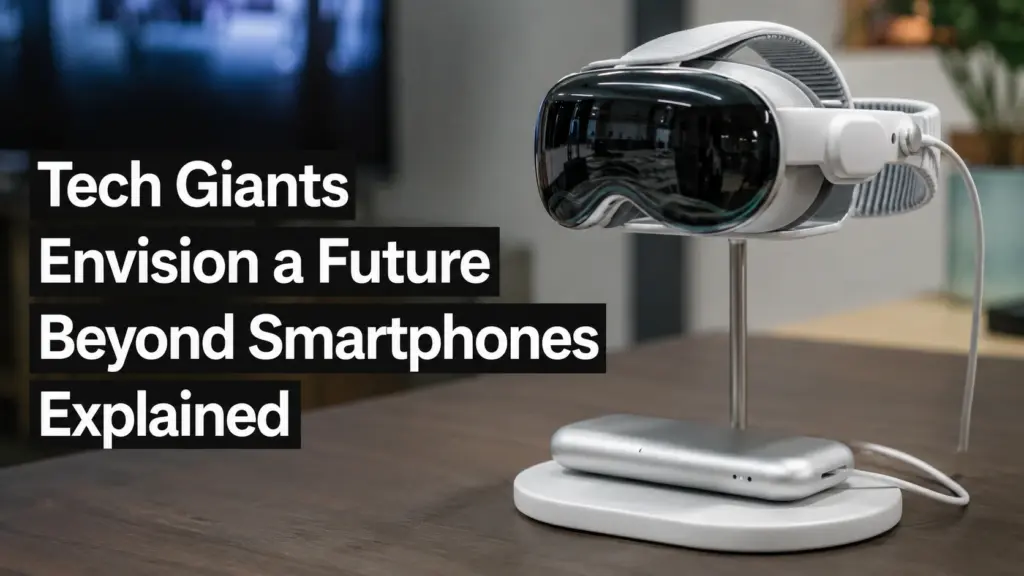
Apple, Google, Meta, Samsung, and other major companies are investing heavily in spatial computing, AI assistants, smart glasses, wearables, and mixed-reality devices. Apple calls Vision Pro the start of the “spatial computing” era, while Google’s Android XR is built for headsets and glasses, with Samsung’s Galaxy XR already launched as the first Android XR device.
Why Phones Feel Less Exciting
Smartphones are still powerful, but yearly upgrades no longer feel revolutionary. Cameras are already excellent, processors are extremely fast, and displays are sharp enough for most users.
For many people, a phone from three or four years ago still works well. That makes it harder for companies to convince customers to upgrade every year.
This slowdown has pushed tech giants to search for the next big platform.
The Rise of Spatial Computing
Spatial computing is one of the biggest signs of the post-smartphone future.
Instead of using apps on a flat screen, users interact with digital content placed around them in physical space. Apple Vision Pro was designed around this idea, blending digital content with the real world for work, entertainment, and communication.
This changes how people may use computers in the future. A desk could become a virtual workspace. A movie could feel like a private theater. A video call could appear as if the person is sitting nearby.
The phone becomes less important when screens can appear anywhere.
Google’s Ambient Future
Google is moving toward a world where technology follows the user across devices instead of staying trapped inside a phone.
Android XR is a major part of that plan. Google describes it as an operating system for headsets and glasses, with more Android XR-powered devices expected in 2026.
This means Google is preparing Android for a future where search, maps, AI, video, communication, and productivity may happen through glasses or headsets.
AI also plays a major role. Google’s Gemini is being positioned as a deeper assistant that can work across apps and devices, reducing the need for constant tapping and scrolling.
Meta’s Bet on Smart Glasses
Meta is one of the most aggressive companies in the race beyond phones.
Its Ray-Ban Meta glasses already combine cameras, audio, AI features, and hands-free communication. Meta’s newer display glasses add in-lens visuals, local search, walking directions, reminders, translations, messaging, and gesture control through a neural wristband.
That matters because glasses feel more natural than headsets. People already wear glasses in daily life. If smart glasses become stylish, light, and useful enough, they could gradually replace many phone interactions.
Instead of pulling out a phone, users could ask an AI assistant, see directions in their view, send messages with gestures, or capture moments hands-free.
Samsung’s Multi-Device Strategy
Samsung is not abandoning smartphones, but it is clearly expanding beyond them.
Foldables, wearables, smart home devices, and XR hardware all show Samsung’s broader direction. Its Galaxy XR headset, launched with Google and Qualcomm support, was introduced as an AI-native device for immersive work, discovery, and entertainment.
Samsung’s strategy is not about one device replacing everything. It is about a connected ecosystem where phones, watches, glasses, headsets, appliances, and AI tools work together.
In that world, the phone becomes one part of the system, not the whole system.
AI Is the New Interface
The biggest change may not be hardware. It may be AI.
Smartphones were built around apps, icons, menus, and touchscreens. AI changes that model. Instead of opening five apps to complete a task, users can simply ask an assistant to do it.
Future AI assistants will summarize messages, book services, manage schedules, search visually, translate conversations, and automate routine tasks.
This reduces dependence on screens. When AI understands context, location, voice, and user habits, computing becomes more natural.
The next major interface may not be a display. It may be conversation.
Why AR Glasses Matter
AR glasses are seen as one of the strongest candidates to replace smartphones as the main personal device.
They can show navigation, messages, translations, reminders, product information, and video calls without forcing users to look down at a screen.
Imagine walking through a city while arrows appear naturally in your field of vision. Or shopping in a store while product comparisons appear instantly. Or talking to someone in another language while subtitles appear quietly in your glasses.
That is the promise tech giants are chasing.
Foldables Are a Bridge
Foldable phones are not the final future, but they are important.
They show that companies are testing new screen sizes and interaction styles. Larger flexible displays help users multitask, watch content, edit documents, and switch between phone and tablet modes.
Samsung, Google, Huawei, and others are using foldables to stretch the smartphone format while preparing users for more flexible computing experiences.
Foldables may not replace phones, but they help move the market away from the old slab design.
The Biggest Challenges
The post-smartphone future still has serious obstacles.
Smart glasses must become lighter, cheaper, stylish, and power-efficient. Headsets must become more comfortable. Developers must rebuild apps for spatial and voice-first experiences.
Privacy is another major concern. Wearable cameras, eye tracking, voice assistants, and location-aware systems raise difficult questions about consent and data security.
People may love convenience, but they will not fully accept these devices unless they trust them.
What Comes Next
The smartphone will remain important for years, but its role is changing.
Between 2026 and 2030, AI assistants, smart glasses, XR headsets, and wearables will continue growing. By the early 2030s, many daily tasks may shift away from phones and into voice, glasses, watches, and spatial screens.
The future will not arrive through one dramatic replacement. It will happen slowly as people use phones less for simple tasks and rely more on intelligent devices around them.
Tech giants are not simply imagining life beyond smartphones. They are already building it.
Apple is pushing spatial computing. Google is expanding Android into XR and AI. Meta is betting heavily on smart glasses. Samsung is building a connected ecosystem across phones, foldables, wearables, and immersive devices.
The smartphone shaped the last generation of technology. The next generation will be shaped by AI, ambient computing, AR glasses, and spatial experiences.
Phones will not vanish. But the screen in your hand may no longer be the center of everything.