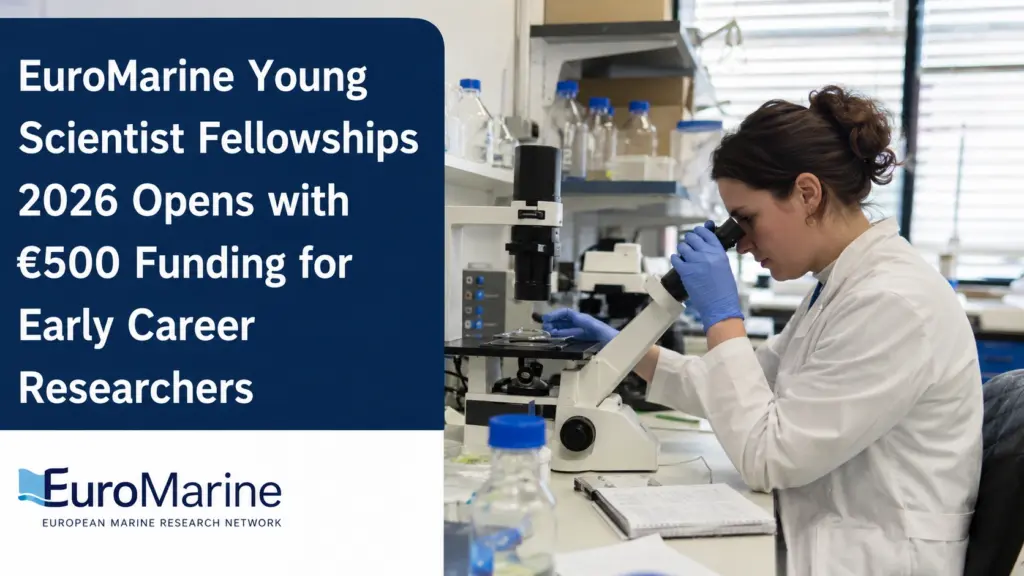
Early career marine scientists across Europe now have a fresh opportunity to strengthen their research careers through the EuroMarine Young Scientist Fellowships 2026 program. The fellowship initiative is designed to help young researchers expand their scientific networks, develop collaborations, and gain international experience within the marine science community.
The program comes with financial support of up to €500 and is aimed at helping researchers travel to laboratories, institutes, workshops, or collaborative scientific activities connected to marine sciences. For many young scientists working with limited project budgets, even a small mobility grant can open doors to meaningful opportunities that may otherwise remain out of reach.
EuroMarine has continued to position itself as one of Europe’s major marine research networks, connecting institutions, universities, and researchers focused on understanding oceans, coastal systems, biodiversity, and climate-related marine challenges.
What the Fellowship Supports
The EuroMarine Young Scientist Fellowship is mainly intended to support short scientific visits and networking activities. Researchers can use the funding to attend collaborative meetings, access laboratory facilities, receive specialized training, or work alongside experts at another institution.
The fellowship is not structured like a long-term scholarship or salary-based research grant. Instead, it acts as a mobility and collaboration support scheme that encourages scientific exchange between institutions connected to marine research.
Successful applicants can use the grant for expenses linked to travel, accommodation, or participation in approved activities. Although €500 may appear modest compared to large research grants, mobility support often plays an important role for early career scientists trying to build partnerships and visibility in competitive academic environments.
Focus on Early Career Researchers
One of the strongest aspects of the fellowship is its focus on researchers at the beginning of their careers. PhD candidates, postdoctoral researchers, and young marine scientists are typically the main target group.
At this stage of a scientific career, international collaboration can significantly shape future opportunities. Researchers who engage with different institutions often gain access to new methods, data sources, technologies, and mentoring relationships that strengthen their academic profile.
Programs like this also help young scientists become more integrated into European research networks. In fields such as marine biology, oceanography, fisheries science, climate research, and marine conservation, collaborative work across borders has become increasingly important.
Growing Importance of Marine Research
The launch of the 2026 fellowship comes at a time when marine science is receiving growing global attention. Oceans are central to discussions around climate change, biodiversity protection, food security, and sustainable economic development.
European researchers are currently involved in projects related to rising sea levels, marine pollution, coral ecosystem damage, fisheries management, renewable ocean energy, and deep-sea exploration. Young scientists entering these fields are expected to contribute innovative ideas and cross-disciplinary solutions.
Because of this, many organizations are investing more resources into supporting the next generation of marine researchers. Small fellowship programs often become stepping stones toward larger international research projects later in a scientist’s career.
International Networking Opportunities
A major attraction of the EuroMarine fellowship is the networking potential it creates. Scientific progress today is heavily dependent on collaboration, especially in environmental and marine fields where data collection and monitoring frequently involve multiple countries.
Researchers participating in exchange visits can establish professional relationships that later develop into joint publications, conference presentations, or larger grant applications.
Networking also benefits researchers personally. Young scientists often face isolation during long research projects, particularly doctoral studies. Meeting peers and senior experts from different institutions can provide encouragement, mentorship, and broader career perspectives.
For many applicants, the fellowship may become their first experience working internationally within a structured scientific network.
Eligibility and Application Interest
While detailed eligibility rules are usually outlined by EuroMarine in its official call documents, applicants are generally expected to demonstrate a connection to marine science research and explain how the fellowship activity will benefit their scientific development.
Strong applications often include a clear purpose for the proposed visit or activity, realistic planning, and evidence that the opportunity will contribute to long-term collaboration.
Interest in the fellowship is expected to remain high because funding opportunities specifically tailored for early career researchers are increasingly competitive across Europe. Smaller grants that offer flexibility and accessibility tend to attract a broad pool of applicants from universities and research institutes.
Applicants are also encouraged to align their proposed activities with broader marine science priorities such as sustainability, climate resilience, marine ecosystems, or ocean innovation.
Why Small Grants Still Matter
In research environments dominated by large-scale funding programs, smaller fellowships sometimes receive less public attention. However, many scientists say these grants can have an outsized impact during the early years of a career.
Travel support may allow a researcher to learn a laboratory technique unavailable at their home institution, meet a future supervisor, or participate in a workshop that shapes an entire research direction.
The EuroMarine fellowship reflects a growing understanding that scientific careers are often built through incremental opportunities rather than single major breakthroughs.
For early career researchers facing rising travel costs and limited university budgets, practical support programs like this remain highly valuable.
A Boost for Europe’s Marine Science Community
The EuroMarine Young Scientist Fellowships 2026 program highlights Europe’s continued investment in collaborative marine research and scientific mobility. By supporting young researchers at a critical stage in their careers, the fellowship helps strengthen future scientific capacity across the region.
As marine and climate challenges become more urgent worldwide, developing well-connected and internationally experienced scientists will remain essential. Programs focused on early career development not only support individuals but also contribute to stronger scientific cooperation across Europe’s marine research community.
For young scientists hoping to expand their expertise, build partnerships, and gain international experience, the 2026 fellowship could become an important step forward in their research journey.