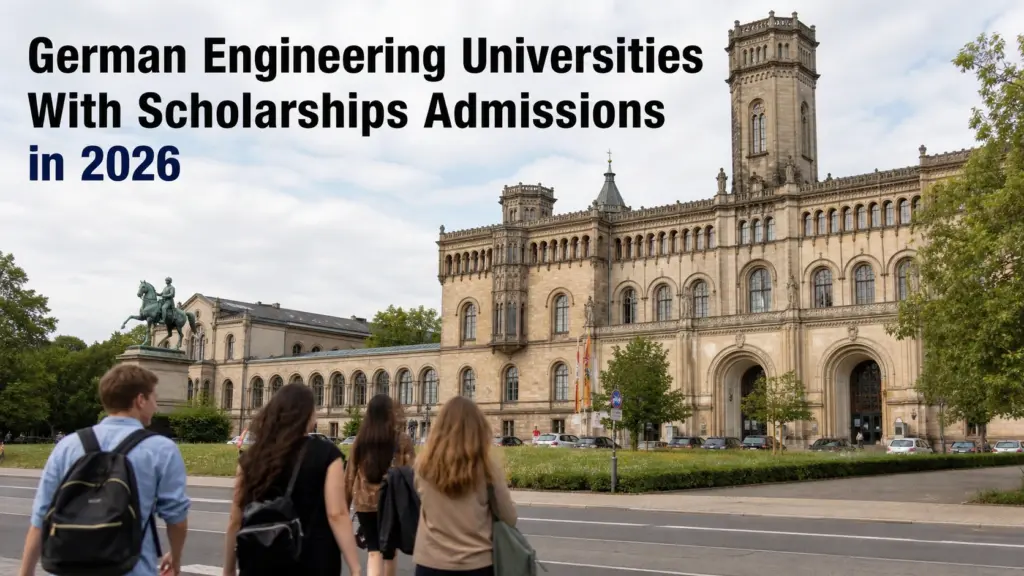
Germany has quietly become one of the most attractive destinations for engineering students worldwide. It is not just because of its reputation for precision and innovation, but because of something more practical. Many top universities offer high-quality education at low or no tuition cost, supported by strong scholarship programs.
For the 2026 admission cycle, international students are once again looking toward Germany not just for degrees, but for a complete academic experience backed by funding, research access, and global recognition.
Why Germany Leads in Engineering Education
Germany’s engineering tradition is deeply rooted. From automotive innovation to renewable energy systems, the country has built its reputation on applied science and technical excellence.
Universities here focus heavily on research and practical learning. Students are not just studying theories. They are working on real-world problems, often in collaboration with industries.
With over 400 universities, many of them ranked globally, Germany offers a wide range of engineering programs across disciplines.
Top Engineering Universities to Consider
Some universities consistently stand out for engineering programs and scholarship opportunities.
Technical University of Munich is often ranked among the best for engineering and technology. It offers strong industry connections and research facilities.
RWTH Aachen University is another major name, especially known for mechanical and automotive engineering.
TU Berlin and Karlsruhe Institute of Technology are also popular among international students for their technical programs and research focus.
These universities do not just offer degrees. They offer environments where engineering ideas are tested and developed.
Scholarships That Make It Possible
One of the biggest reasons students choose Germany is the availability of scholarships. The most well-known is the DAAD scholarship, which supports international students across multiple disciplines, including engineering.
DAAD funding can include monthly stipends of around €934 for master’s students and €1,200 for doctoral candidates, along with travel, insurance, and living support.
There are also other funding options like:
Deutschlandstipendium, which supports high-achieving students regardless of nationality.
Heinrich Böll Foundation scholarships, focused on academic excellence and social engagement.
Konrad-Adenauer-Stiftung scholarships, which support postgraduate and doctoral students.
These programs make it possible to study in Germany without the heavy financial burden seen in many other countries.
Fully Funded Opportunities for 2026
For the 2026 cycle, several fully funded scholarships are expected to open across engineering fields.
Programs like DAAD and foundation scholarships often cover tuition fees, monthly living expenses, and additional costs such as accommodation and travel.
Some research-focused scholarships also provide contracts with salaries, especially at the PhD level. This means students are not just studying, but actively contributing to research projects.
Admission Requirements You Should Know
Getting into a German engineering university requires preparation. While requirements vary by institution, there are some common elements.
A strong academic background in science or engineering is essential.
Proof of language proficiency is often required. This could be English (IELTS or TOEFL) or German, depending on the program.
For postgraduate programs, a clear statement of purpose and sometimes a research proposal are expected.
Some scholarships also require work experience or a demonstrated interest in development-related fields.
Studying Engineering Without Tuition Fees
One of the most appealing aspects of Germany is that many public universities charge little to no tuition fees. This applies to both domestic and international students.
Students mainly pay a semester contribution, which covers administrative costs and sometimes public transport.
This model allows students to focus on learning rather than worrying about large student loans.
Life as an Engineering Student in Germany
Studying in Germany is not just about academics. It is also about adapting to a new environment.
Cities like Munich, Berlin, and Aachen offer a mix of modern infrastructure and student-friendly living. Many universities are closely connected to industries, giving students opportunities for internships and practical experience.
The academic culture encourages independence. Students are expected to manage their time, engage in research, and take initiative in their learning.
Career Opportunities After Graduation
Germany’s strong industrial base creates excellent career opportunities for engineering graduates.
Many students find internships during their studies, which often lead to full-time roles. Fields like automotive engineering, robotics, renewable energy, and data science are especially in demand.
Graduates also benefit from Germany’s post-study work opportunities, allowing them to stay and gain professional experience.
Tips to Strengthen Your Application
Preparation is key when applying for engineering programs and scholarships in Germany.
Start early by researching universities and scholarship deadlines. Many programs have specific timelines that must be followed closely.
Focus on building a strong application with clear academic records and a well-written motivation letter.
If applying for scholarships like DAAD, make sure your profile aligns with their criteria, including academic excellence and future goals.
A Smart Choice for Future Engineers
Germany offers something that is becoming rare in higher education. Quality, affordability, and global recognition in one place.
For engineering students, the combination of top universities, strong industry connections, and generous scholarships makes it a practical and ambitious choice.
The 2026 admissions cycle is not just another opportunity. For many, it is the beginning of a career shaped by innovation, research, and real-world impact.